- Bolt Graphics is building a RISC-V based GPU to challenge Nvidia
- CUDA support on RISC-V could lower software barriers for alternative accelerators
- Zeus targets path tracing, HPC, and large memory workloads over traditional shaders
Bolt Graphics is moving forward with its ambitious plan to take on Nvidia and AMD by developing a graphics processor based on a RISC-V architecture instead of a conventional GPU design.
The startup, located in Sunnyvale, California, has introduced the Zeus architecture, which reimagines graphics, rendering, and high-performance computing tasks.
Rather than depending on traditional shader-heavy designs, Zeus integrates fixed-function hardware for rasterization, ray tracing, and path tracing, complemented by an in-house SIMD engine.
A Standalone Linux System
The command and scheduling functions are managed by a RISC-V processor that also acts as a general-purpose CPU, enabling Zeus to operate as a standalone Linux system without relying solely on a host processor.
We previously covered Bolt and Zeus in 2025, and the company showcased its plans at CES 2026, which appear increasingly feasible following Nvidia's decision to extend CUDA support to RISC-V systems.
With CUDA no longer exclusively linked to x86 or Arm hosts, a RISC-V based accelerator stack becomes a more viable option for developers already engaged with Nvidia’s software ecosystem.
Zeus cards are compatible with Vulkan and DirectX 12, as well as engines like Unreal and Unity, and support common programming environments used in HPC, including Python, Fortran, and OSL compiled through LLVM.
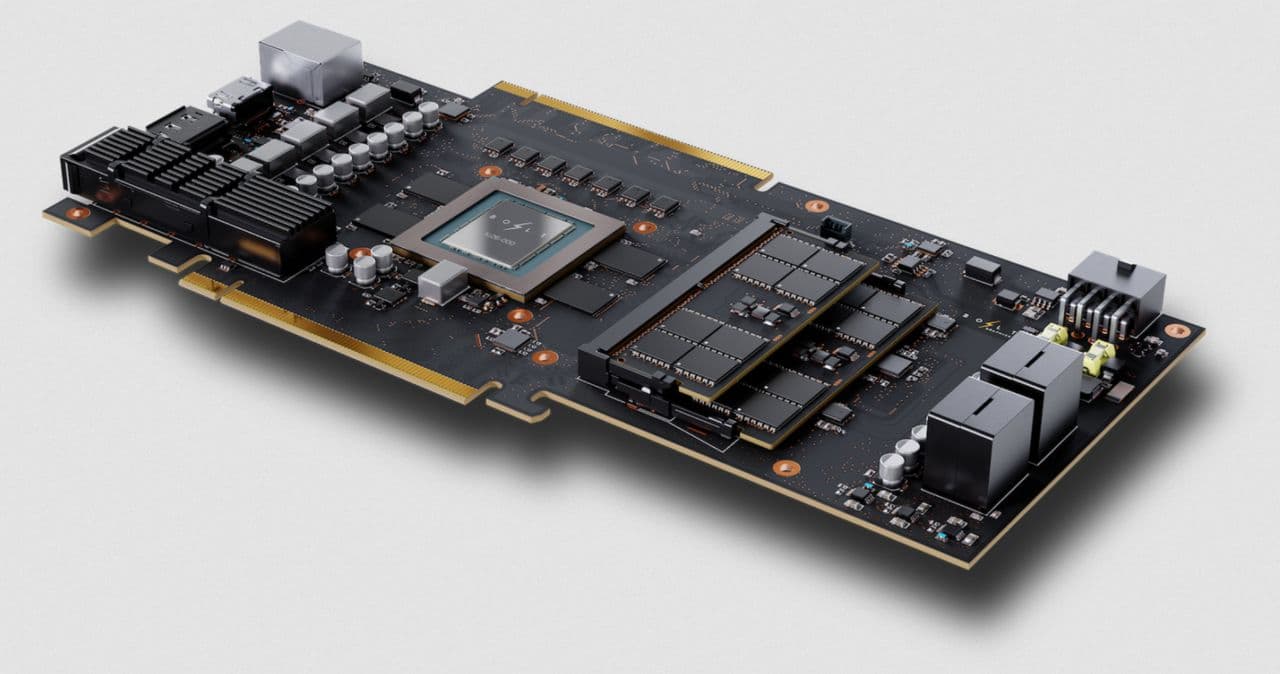
The prototype add-in card utilizes a PCIe 5.0 x16 interface and combines LPDDR5X graphics memory with DDR5 SODIMM slots for the RISC-V processor.
Depending on the configuration, the total memory capacity can reach up to 384GB on a single board.
Bolt plans to release several Zeus variants, including the Zeus 1c26-032, Zeus 2c26-064, Zeus 2c26-128, and Zeus 4c26-256, covering single-chip PCIe cards and multi-chip 2U server designs with a combined memory capacity exceeding 2TB.
Networking capabilities are enhanced with integrated 400Gbps and 800Gbps interfaces designed for render farms and clustered workloads, allowing direct GPU-to-GPU connections without the need for separate network interface cards.
The board also features BMC and IPMI hardware, which are typically found in servers rather than consumer graphics cards.
Power consumption is kept in check for its class, with the card relying on a single 8-pin PCIe connector for up to 225W, while higher-end server configurations can scale up to 500W.
Bolt has made some intriguing performance claims, suggesting path tracing throughput significantly surpassing Nvidia’s RTX 5090 and substantial improvements in FP64 simulation workloads.
These figures are based on internal testing and simulations, with actual hardware validation still pending.
If CUDA on RISC-V gains traction, Bolt’s approach could encounter fewer software barriers than similar initiatives in the past.
While execution risks remain, the technical direction indicates that Bolt is banking on shifts in the ecosystem rather than relying solely on brute force scaling.
Via TechPowerUp